Table of Contents
Let’s tackle the next chapter of babyheap, this one is a bit more exotic…
scanf and black magic
Let’s examine the menu’s scanf input function.
Question: how can you send it an arbitrarily long number without triggering a buffer overflow?
Answer: it uses the heap.
Ocean of scanf
//babyheap main functionprintf("Menu:\n1) Create\n2) Read\n3) Update\n4) Delete\n0) Quit\n> ");if ( (unsigned int)__isoc99_scanf(" %d", &v4) != 1 ){ puts("Invalid input"); exit(0);}But if scanf() always uses the heap then why don’t we see tcache chunks in the free list after every execution? To understand what is going on, let’s start gdb and set a breakpoint at *malloc.
If we send 42 to scanf, malloc doesn’t get called, but when we send a very big number, the program breaks at a malloc call! Using finish we can exit the malloc call and see the function that executes it:
0x7ffff7ca9a3b <__GI___libc_scratch_buffer_grow_preserve+107>: call QWORD PTR [rip+0x15f597] # 0x7ffff7e08fd8 (malloc)=> 0x7ffff7ca9a41 <__GI___libc_scratch_buffer_grow_preserve+113>: mov rdi,raxlibc_scratch_buffer_grow_preserve() Is our perpetrator then, but let’s step back and follow the implementation of vfscanf(): after “%d” gets read by vfscanf, it enters a loop where every iteration a char is taken from stdin using incchr() and moves the character into a charbuffer by calling char_buffer_add() till an EOF is found or its width becomes zero.
//glibc internals https://elixir.bootlin.com/glibc/glibc-2.42.9000/source/stdio-common/vfscanf-internal.c#L1823
while (c != EOF && width != 0){  ... a LOT of stuff ...
  char_buffer_add (&charbuf, c); <-- wrapper around wrapper around grow_preserve  if (width > 0)    --width;
  c = inchar ();}
It then adds a zero byte at the end to transform the number into a string and executes __strtol_internal, this function transforms the string into a long integer.
//glibc internals https://elixir.bootlin.com/glibc/glibc-2.42.9000/source/stdio-common/vfscanf-internal.c#L1932
/* Convert the number.  */char_buffer_add (&charbuf, L_('\0'));if (char_buffer_error (&charbuf)){  ... error stuff ...}if (need_longlong && (flags & LONGDBL)){  ... if a longlong is needed stuff ...}else{  if (flags & NUMBER_SIGNED)num.l = __strtol_internal                                    //<-- HERE  (char_buffer_start (&charbuf), &tw, base, flags & GROUP);  elsenum.ul = __strtoul_internal  (char_buffer_start (&charbuf), &tw, base, flags & GROUP);}
But by setting “%d” didn’t we want to save an integer? Why is the string converted into a long integer? Don’t worry, shortly after the above code the number gets cast into the right format and moved into the argument given to scanf():
//glibc internals https://elixir.bootlin.com/glibc/glibc-2.42.9000/source/stdio-common/vfscanf-internal.c#L1961
if (!(flags & SUPPRESS)){  if (flags & NUMBER_SIGNED)  {    if (need_longlong && (flags & LONGDBL))    *ARG (LONGLONG int *) = num.q;    else if (need_long && (flags & LONG))    *ARG (long int *) = num.l;    else if (flags & SHORT)    *ARG (short int *) = (short int) num.l;    else if (!(flags & CHAR))    *ARG (int *) = (int) num.l;                    //<-- long to int and stored in the    else                                             //    argument given to scanf    *ARG (signed char *) = (signed char) num.ul;  }  else  {    ... same as above but unsigned ...  }
  ... more stuff...}
Now we know how a number gets transformed into an integer. But we ignored a key aspect of this code: char_buffer_add moves characters from stdin into a buffer, so let’s understand how the function works.
This function is a wrapper around char_buffer_add_slow() which uses a scratch_buffer to save data:
//glibc internals https://elixir.bootlin.com/glibc/glibc-2.42.9000/source/include/scratch_buffer.h#L66struct scratch_buffer { void *data; /* Pointer to the beginning of the scratch area. */ size_t length; /* Allocated space at the data pointer, in bytes. */ union { max_align_t __align; char __c[1024]; } __space;};This struct contains a pointer to a writable buffer (*data), the length of said buffer (length), and the 1024 byte memory area itself (__space).
In the initialization process of the scratch_buffer the address of the memory area gets stored in *data, if more than 1024 bytes must be stored, char_buffer_add_slow() will call __libc_scratch_buffer_grow_preserve, this functions allocates a new buffer in the heap with double the size and modifies the *data pointer and the length.
This is why malloc gets called only when big numbers are sent to scanf, we need more than 1024 characters to trigger the heap allocation.
//glibc internals__libc_scratch_buffer_grow_preserve (struct scratch_buffer *buffer){  size_t new_length = 2 * buffer->length; <--- 1024 * 2  void *new_ptr;
  if (buffer->data == buffer->__space.__c)    {  /* Move buffer to the heap.  No overflow is possible because  buffer->length describes a small buffer on the stack.  */  new_ptr = malloc (new_length);                   //<-- HERE WE BREAKED  if (new_ptr == NULL)    return false;  memcpy (new_ptr, buffer->__space.__c, buffer->length);    }  else    {  /* Buffer was already on the heap.  Check for overflow.  */  if (__glibc_likely (new_length >= buffer->length))    new_ptr = realloc (buffer->data, new_length);    else  {    ... error stuff ...  }
    if (__glibc_unlikely (new_ptr == NULL))  {    /* Deallocate, but buffer must remain valid to free.  */    free (buffer->data);    scratch_buffer_init (buffer);    return false;  }    }
  /* Install new heap-based buffer.  */  buffer->data = new_ptr;  buffer->length = new_length;  return true;}
Now we know in which situation malloc gets called from scanf, but how can this be helpful to our purpose of leaking a libc address pointer? The scratchpad gets freed after usage and removed from the heap, so how can we maintain a freed chunk in the small or large bins with this knowledge? It seems that our deep dive is not finished yet… enter the depths of malloc.
Deep into malloc
Looking at the malloc() implementation inside libc, we notice that if the requested chunk is larger than the biggest chunk size stored in the smallbins, malloc_consolidate() is called.
//glibc internalsstatic void *_int_malloc (mstate av, size_t bytes){  INTERNAL_SIZE_T nb;               /* normalized request size */
  ... to much stuff here, like a loooot ...
  if (in_smallbin_range (nb))  {      ... a bit of stuff here ...  }    else    {      /*       If this is a large request, consolidate fastbins before continuing.       While it might look excessive to kill all fastbins before       even seeing if there is space available, this avoids       fragmentation problems normally associated with fastbins.       [...]    */
      idx = largebin_index (nb);      if (have_fastchunks (av))        malloc_consolidate (av);     //<--- oh look, malloc_consolidate    }
    ... a league of legends lootbox full of stuff here ...}
The macro in_smallbin_range(nb) is a simple check that returns if the size of the chunk is small enough to stay in smallbins, by looking below we can calculate the smallbin max chunk size as 0x400.
//glibc internals#define NBINS             128#define NSMALLBINS         64#define SMALLBIN_WIDTH    MALLOC_ALIGNMENT ` \\ normally 16#define SMALLBIN_CORRECTION (MALLOC_ALIGNMENT > CHUNK_HDR_SZ)#define MIN_LARGE_SIZE    ((NSMALLBINS - SMALLBIN_CORRECTION) * SMALLBIN_WIDTH)
#define in_smallbin_range(sz)  \  ((unsigned long) (sz) < (unsigned long) MIN_LARGE_SIZE)
So what happens if we create a chunk bigger than 0x400 bytes? To answer that, we need to understand what malloc_consolidate does.
This means that if we generate a fastbin chunk and trigger in some way malloc_consolidate the generated fastbin chunk gets moved into the smallbin even if it’s a small chunk. Reading this chunk gives us a libc leak.
But as we discovered before, to execute malloc_consolidate we need to allocate a chunk of size 0x400 or greater, this is where our scanf trick comes handy.
Putting it all together.
We start by generating eight chunks (7 tcache + 1 fastbin) and free them in a particular order to guarantee that the fastbin chunk is not the last one in heap memory. Else, the fastbin chunk would simply be trimmed by malloc_consolidate.
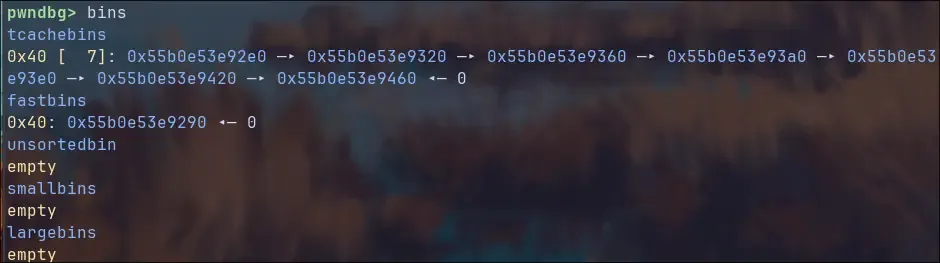
Now we can apply the knowledge gotten from scanf and malloc, let’s allocate a chunk big enough to trigger a malloc in scanf, and greater than the smallbin max size to trigger malloc_consolidate.
To achieve this we can send b"1"*0x500 to scanf, this is bigger than 0x400 so both scratch_buffer_grow_preserve() and malloc_consolidate() get triggered. The fastbin chunk gets moved to the unsortedbin and then into the smallbin list once the big chunk gets freed after scanf got called.
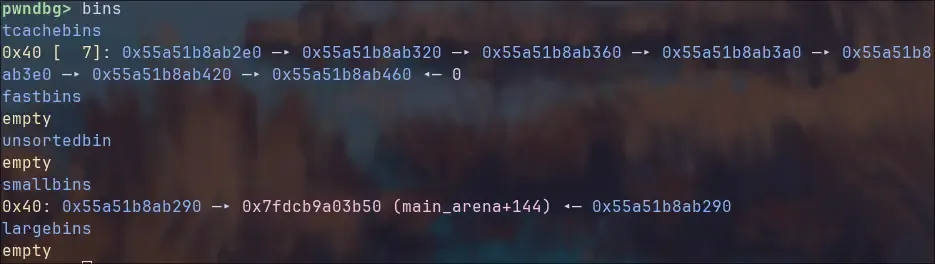
by using chunk_read() on the first chunk we can leak the libc address!!!!!!!
Exploiting with exit_func overwrite
Looking at the exit() function, we notice that it is only a wrapper around __run_exit_handlers().
//glibc internalsvoid exit (int status){ __run_exit_handlers (status, &__exit_funcs, true, true);}This function executes so-called exit_functions saved into the __exit_funcs global structure. Exit functions can also be registered by the user using atexit().
//example snippet#include <stdio.h>#include <stdlib.h>
void cleanup1(void) { puts("cleanup1"); }void cleanup2(void) { puts("cleanup2"); }
int main(void) {    atexit(cleanup1);    atexit(cleanup2);    printf("Exiting...\n");    return 0; // triggers cleanup2 then cleanup1}
So, what exactly is an exit_function?
Looking at the code below, we can see that an exit_function is a struct that wraps a function call. The flavor field indicates that there are multiple types of exit functions that take different combinations of arguments.
//glibc internalsstruct exit_function { long int flavor; union { void (*at) (void); struct { void (*fn) (int status, void *arg); void *arg; } on; struct { void (*fn) (void *arg, int status); void *arg; void *dso_handle; } cxa; } func; };Looking at the snippet run_exit_handlers() below we can see how the flavors change the execution of an exit function:
- ef_free: slot is dead, ignore
- ef_us: nothing happens
- ef_on: status code as first argument and user supplied argument as second one
- ef_at: function without arguments
- ef_cxa: the important one, first argument is user supplied and second one is the status code.
Question: Why is ef_cxa the best flavor?
Answer: We can overwrite the function pointer with system() and set the first argument as /bin/sh
//glibc internals__run_exit_handlers (int status, struct exit_function_list **listp,      bool run_list_atexit, bool run_dtors){
...
while (cur->idx > 0)  {  struct exit_function *const f = &cur->fns[--cur->idx];  const uint64_t new_exitfn_called = __new_exitfn_called;
  __libc_lock_unlock (__exit_funcs_lock);  switch (f->flavor)  {    void (*atfct) (void);    void (*onfct) (int status, void *arg);    void (*cxafct) (void *arg, int status);
    case ef_free:    case ef_us:      break;      case ef_on:      onfct = f->func.on.fn;      onfct (status, f->func.on.arg);      break;      case ef_at:      atfct = f->func.at;      atfct ();      break;      case ef_cxa:      f->flavor = ef_free;      cxafct = f->func.cxa.fn;      cxafct (f->func.cxa.arg, status); // <-- cxa is executed here      break;  }    __libc_lock_lock (__exit_funcs_lock);    if (__glibc_unlikely (new_exitfn_called != __new_exitfn_called))      goto restart;  }
...
}
Putting it all together
In practice, we are going to inspect the exit handler array entries, look for an exit handler with flavor == 4 (ef_cxa) to overwrite with a pointer to system(), and then set /bin/sh as its first argument. Getting a shell from there is as easy as executing the binary and exiting.
Step 1: Getting the __exit_funcs struct
Using our libc leak obtained before, we get the __exit_funcs struct by summing the offset of the struct with the libc base address. libc uses the symbol initial to point at the exit_funcs, if needed, bigger arrays can be generated to extend the number of exit functions that can be registered, this one is the initial array that always exists:
__exit_funcs = libc_base + libc.symbols.initialWe then overwrite the first tcache forward pointer with this address, remember that when malloc is called the first 16 bytes get zeroed out.
After calling malloc() twice, the second call will return a pointer to the initial struct, now we can edit and read from it.
pwndbg> tele 0x7f3046204fc0 <-- libc_base + initial offset00:0000│ 0x7f3046204fc0 (initial) ◂— 001:0008│ 0x7f3046204fc8 (initial+8) ◂— 1 <-- number of registered funcs02:0010│ 0x7f3046204fd0 (initial+16) ◂— 4 <-- flavor03:0018│ 0x7f3046204fd8 (initial+24) ◂— 0x91b97d6d433887e0 <-- function addrs04:0020│ 0x7f3046204fe0 (initial+32) ◂— 0 <-- argument... ↓ 3 skippedLooking at the output from pwndbg above, we notice only one entry in the array, fortunately this is a ef_cxa entry, now we only need to replace it with the system() function.
Step 2: Replacing function with system()
Do you notice something wrong with the function address in the snipped above? That’s not an address. When an atexit function gets registered, its address is xored with a key called pointer_chk_guard and then rotated left by 17 bits (0x11).
But by performing a ROR (rotate right) by 0x11 bits on the mangled address and then XORing the result with the real address, we can easily recover the key.
Once we have the key, we can replace the old mangled function address with the mangled system() address and overwrite the argument 0 with /bin/sh\0.
But how do we get the unmangled address to recover the key?
Set a breakpoint at exit() and let the program hit it, then step till you find the ROR and XOR instructions. After the runtime demangles the function pointer you can read the real pointer.
Unfortunately, in our case the registered functions position is not relative to libc but to the dynamic loader (ld). Fortunately, the libc contains pointers into the loader mapping, so you can find those with p2p libc ld and use them to resolve the loader base.
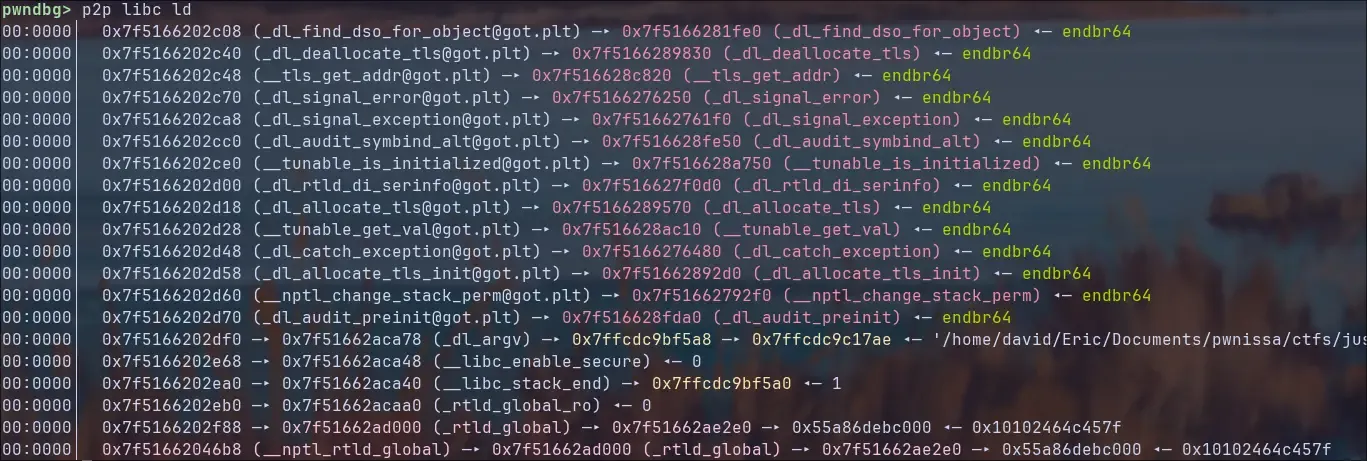
Using the same tcache poisoning technique we applied to read and modify the exit function array, we can also leak the loader’s address.
We’ll use the last pointer in the output from p2p, since malloc() writes directly into the allocated area before being able to read meaning we need a writable leak.
Once again, we overwrite the first tcache chunk’s forward pointer with this address, allocate two chunks, and then read from the second one to obtain the loader leak.
Step 3: exiting gracefully
Now we have everything to get the key, by overwriting the struct with the mangled system() address and /bin/sh as a
rgument we simply need to run the program and exit to get a shell.
Still questions about __exit_functions? Here is a link to a nice blogpost.