Table of Contents
Normally, especially for beginners, seeing a baby challenge is always a very refreshing alternative to the high level tasks made to challenge also the best of players.
You solve a very simple challenge and have the possibility to encounter a new technique in a simple and protected setting. Baby heap breaks one of these assumptions, to be fair, it was never written which type of baby is intended in the title, a newborn beluga whale for example can weight even kg, enough to crush my sanity.
By the end of this write-up, I hope you’ll understand both my frustration and my realization: maybe my assumptions about baby challenges were wrong from the start. In fact, I learned more about libc internals and exploitation techniques in this single challenge than in all the other “baby” ones combined.
This is a two-part journey: from simple heap exploitation to advanced techniques, and finally, as dessert, an exit_function overwrite and environ leak.
The disassembly
As usual, we are not going to look at the entire binary, but instead focusing on the relevant parts. For context, the program is straightforward:
create_chunk()Allocates a buffer of size0x30.modify_chunk()Allows you to overwrite the contents of an existing chunk.read_chunk()Reads the full0x30bytes from a chunk.delete_chunk()Frees the chunk.
We are gonna concentrate on two of these functions:
//babyheapint create_chunk(){  int index; // [rsp+Ch] [rbp-4h]
  index = get_index();  if ( *((_QWORD *)&chunks + index) )  return puts("This index is already in use");  *((_QWORD *)&chunks + index) = malloc(0x30uLL);  printf("Content? ");  printf("Content? "); //wtf why?  return read(0, *((void **)&chunks + index), 0x30uLL);}
As described above, this function creates a chunk and saves the address to an array of max entries, if the entry is occupied it returns without allocating and gives an error message.
//babyheapvoid delete_chunk(){  int index; // [rsp+Ch] [rbp-4h]
  index = get_index();  if ( *((_QWORD *)&chunks + index) )    free(*((void **)&chunks + index));  else    puts("This chunk is empty");}
Looking at the delete_chunk()function we notice that it doesn’t remove the address from the array once deleted. This has a few implications, first it is possible to read and write to a freed chunk, and second, once created a chunk you cannot call a second time create_chunk() on the same index, this limits our create_chunk() calls to maximum 20.
Heap Exploitation
When malloc() is called, generally, a memory address to the heap is returned, this address points to the user data of a struct, the sections above contain important metadata. We like to call this memory areas chunks.

From now one we will consider the header part of the chunk, so it’s size becomes 0x40 instead of 0x30.
Looking at the chunks header, we notice a few significant fields: The size field stores the amount of bytes that divide this chunk from the next one, yet nothing stops us from writing more bytes than the amount specified in the size field.
Another interesting part is the P flag, if prev_used is set, free() knows that the previous chunk is currently allocated, if the flag isn’t set, the allocator could try to fuse together the two chunks to create a bigger one.
The bins
When a chunk is freed, from LIBC-2.26 onwards the deallocator first tries to place an address pointing to the user data as the first element of a per-size-class singly linked list called the tcache, which can hold up to 7 elements in every class of max 0x410 bytes of size.
In the free operation, the first 0x10 bytes of the user data are overwritten with a pointer to the next chunk in the list (fd) and a random value called tcache key used to prevent double frees (not to be confused with the tcache mangling key explained later in this chapter). This means that when a freed chunk is read, you won’t read the content it stored before but a pointer to a previously freed chunk or, if this is the first freed chunk, a null pointer.
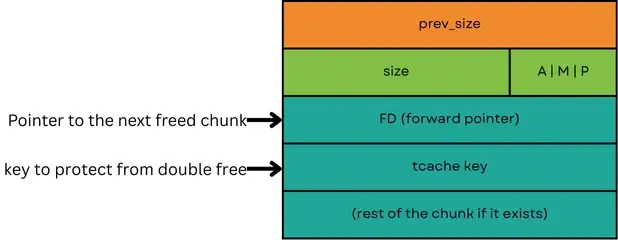
If more than 7 chunks of the same size are freed, and the chunk is between 0x20 and 0x80 bytes long, the allocator adds them into the fastbin. Fastbins have no limit on the number of chunks they can store, but are limited by the before mentioned size classes, also the fd pointer doesn’t point to the next fd pointer but to the prev_size field.
If the tcache is full and the elements are not compatible with the fastbin size-classes, or in very specific cases when mechanisms trigger fastbin consolidation (foreshadowing), chunks are placed into the unsortedbin. From there they can get sorted into largebins or smallbins.
This last three bins are implemented as doubly-linked circular lists. These have their head stored in the libc address space, to be more precise, in the main_arena, and because of the circular nature of these lists, the last element has a forward (fd) pointer to the head of the list stored in the arena, also because of the double-link, the first element has a backwards pointer (bk) to it too. So by reading a freed chunk in these bins you can receive a libc leak.
tcache poisoning
If this binary had Partial RELRO and was non-PIE, we could have allocated two chunks and then freed them.
Once freed, both chunks would be placed into the tcache linked list, and where their data once resides, pointers to the next chunk in the linked list would now be written. By modifying the last freed chunk’s forward pointer (first element in the tcache list) to point to something like the GOT, the allocator would think that the first deallocated chunk (second element in the tcache) is stored in the GOT table.
Then, by reallocating the two chunks, the allocator would return the address of the GOT as the second allocation (the first 16 bytes get zeroed out, look at the note below), we could then:
- Read from the GOT by reading from the second chunk to leak a libc address, but this only works with ‘fwrite()’ or similar because the first 0x10 bytes are null pointers terminating ‘printf’ or ‘puts’ instantly.
- Overwrite a GOT entry (
free) with the address ofsystem(), giving us a shell the next time that function is called.
But that’s not the case here… behold:
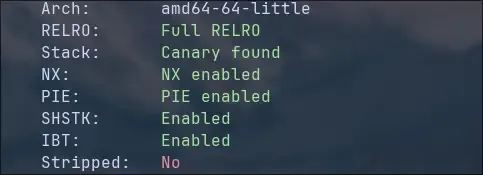
Still, this very simple technique called tcache poisoning will prove useful several times throughout this writeup.
But let’s exit this hypothetical scenario and focus on the real limitations we face: the binary has no apparent address leak and no buffer overflow, we need to take control in some other way.
The Plan
Our actual goal is to gain arbitrary read and write primitives within libc. With these, we can leak crucial pointers like __envrion, __exit_functions or other stuff, and eventually get to a shell.
At this point, it’s worth clarifying that I didn’t solve this challenge during the competition itself. Instead, I studied various writeups to deeply understand the possible solutions and their underlying mechanics.
I’ll present two methods to leak a libc pointer, followed by two techniques to leverage that leak to achieve a shell. The first leak and exploit can be found in this part, the second part includes a more exotic variant.
House of something
As explained in the heap primer, the heads of the linked lists for smallbin, largebin, and unsortedbin live in main_arena inside libc. Those lists are doubly linked and circular. If we can move a chunk into one of those bins we can read the fd pointer that points back into libc and obtain a libc leak usable later.
Sending a chunk into those bins requires freeing a large enough chunk. The tcache holds chunks up to size 0x410 (inclusive), so we must either create a single chunk larger than 0x410 or free more than seven smaller chunks while avoiding the fastbin path (above 0x80 bytes), we will try to deallocate a 0x410 or greater size chunk.
Reasoning about chunks
Question: By manipulating a chunk’s fd pointer (tcache poisoning) to position the next chunk in the tcache list just above a previously allocated third chunk, is it possible to use the first chunk to alter the size metadata of the second chunk, so that when the third chunk is freed, the allocator interprets its size as 0x420 bytes and moves the chunk into unsortedbin?
In theory, yes, but with important caveats. We must have a second chunk immediately after our forged chunk (including it’s modified size), in this way when we free the giant chunk it doesn’t get trimmed away.
Targeting a 0x420 size will cross past the current top chunk, so we need to allocate enough intermediate chunks until our guard chunk (the second chunk mentioned before) sits directly after our forged chunk. Only then can freeing the forged chunk make the allocator interpret a 0x420 size and move the chunk to unsortedbin instead of trimming it away, producing the desired libc leak.
To guarantee that an extra chunk is placed immediately behind our forged 0x420 chunk we expand the forged size slightly to 0x440. Because small chunks are 0x40 bytes, the 0x440 size ensures the forged chunk completely overlaps the final small chunk in that region.
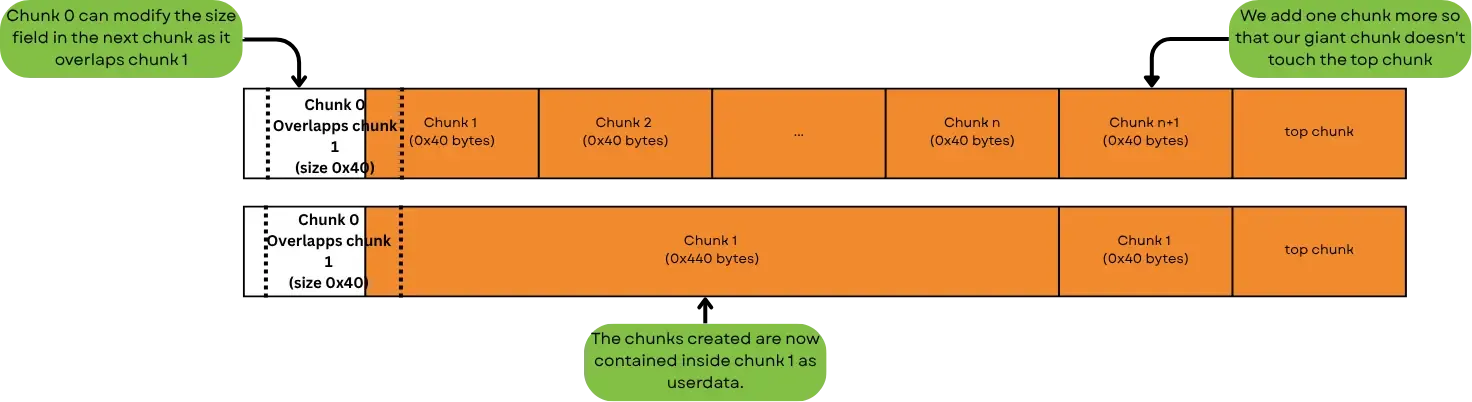
But it’s not so simple, with 19 allocations we don’t have enough chunks to push the top chunk behind our forged one and also have enough allocations to do some tcache poisoning for our final exploitation. We need another strategy.
tcache_perthread_struct
The Tcache has a significant property that the other bins don’t have, it is local to a specific thread, if more threads are present in the process, more tcaches are created. To make this work, for every thread a tcache struct called tcache_perthread_struct is allocated that contains the heads of the linked lists and the number of freed chunks. For our primary thread the 0x290 bytes long perthread_struct is allocated at the top.
//glibc internals https://elixir.bootlin.com/glibc/glibc-2.42/source/malloc/malloc.c#L3127typedef struct tcache_perthread_struct{ uint16_t num_slots[TCACHE_MAX_BINS]; tcache_entry *entries[TCACHE_MAX_BINS];} tcache_perthread_struct;By using the heap command in pwndbg we can spot the perthread chunk (first one), the second one is a 0x40 chunk created through the menu of the program and the last on is the topchunk:
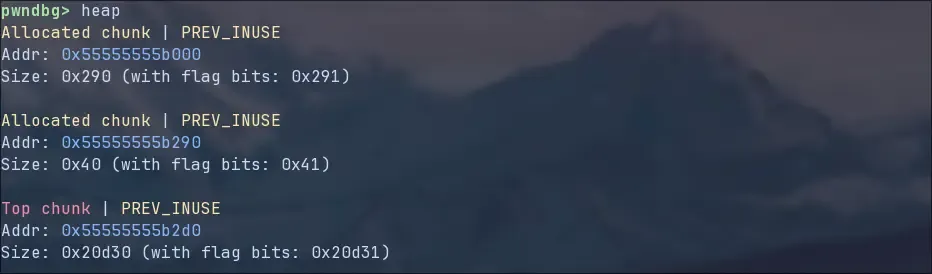
So, could we use this chunk as our forged chunk?
Yes. Even though we never directly allocated this chunk and thus did not receive its pointer, we can still allocate a new chunk that completely overlaps the first 0x40 bytes of the perthread_struct. From there, we can modify its size field using a slightly overlapping chunk, just like the technique described earlier. By adding new chunks the allocator will place them after the 0x290 perthread_chunk like in the image above.
This approach significantly reduces the number of required allocations to correctly position the guard chunk, from 16 allocations (excluding the guard and the two overlapping chunks) down to just 6.
The main drawback is that the perthread_struct becomes corrupted, breaking the tcache metadata, in particular the amount of stored chunks saved at the beginning of the struct get zeroed out by the allocation and filed with values at the deallocation. Nevertheless, this appears to be our only viable option for obtaining a chunk large enough for the intended purpose.
You are 0x440 bytes big, trust me
Talk is cheap, so let’s move to the practical part.
We’ll use tcache poisoning to place a chunk precisely at the location of the perthread_chunk the deallocator will mistake the perthread_chunks size as the one of our own chunks. Then, we allocate a second chunk and poison the tcache again so that it partially overlaps the perthread/fake-chunk metadata. This overlapping chunk gives us write access to the perthread metadata, allowing us to modify its size field from 0x290 to 0x440.
Next, we allocate enough chunks to push the top chunk downward, six allocations plus the guard chunk.
By looking at the addresses of the chunks in the image below we can notice the modified perthread chunk with the guard chunk right beneath it.
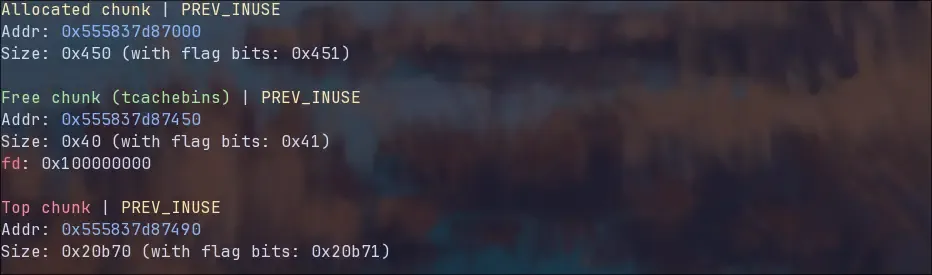
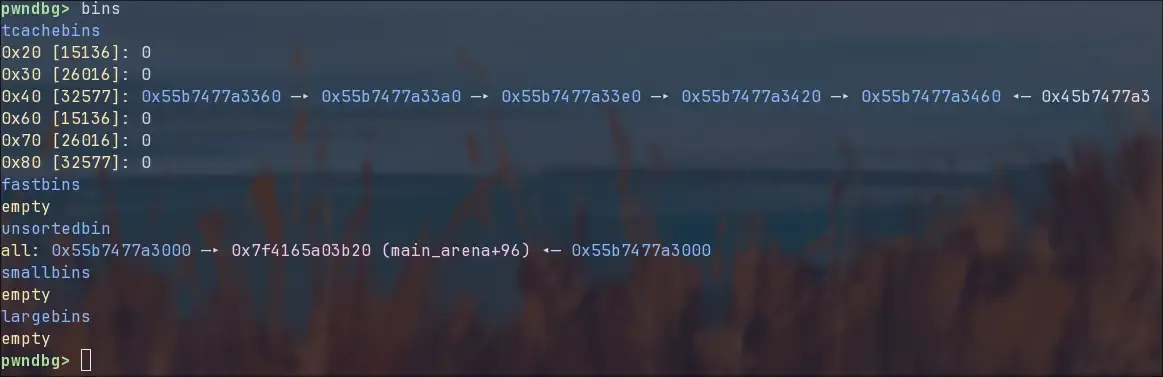
Finally, we free the chunk placed over the perthread structure, the deallocator will check the size and moves the pointer to the unsorted bin. During this process, the unsorted bin writes fd (forward) and bk (backward) pointers into the freed chunk; these pointers reference main_arena. Reading from the freed chunk’s user area thus reveals a libc pointer leak!.
ROP exploit using __environ
Once we have arbitrary read and write into the libc getting a leak to the stack is very simple, enter __environ.
The __environ variable
__environ is a global variable pointing to the environment variables saved on the stack:
environ = libc_base + libc.symbols.__environThe ROP chain
We can use tcache poisoning to overwrite the fd pointer of the first freed chunk with the address of __environ. After allocating twice, the second allocation will return a chunk overlapping the __environ pointer.
Keep in mind: malloc() zeroes out the first 0x10 bytes, so we must allocate at an offset. In this case, we offset by 0x18 because chunks must also be aligned to 0x10:
environ_leak = u64(read(r, 10)[0x18:0x20])From here we get the environment stack variables and subtract the main return address from it, we get a permanent offset that when added on our environ leak will yield us the main address.
Using our tcache poisoning technique again, we can modify the return address and set a ROP gadget chain, I opted for:
pop_rdi = libc_base + 0x000000000010f75bbinsh = libc.binsh() + libc_baseret = pop_rdi + 1system = libc_base + libc.symbols.system
return_pointer = environ_leak - 0x130 # 0x130 is the offset from environ to main returnupdate(r, 9, p64((return_pointer-0x08) ^ mask)) # 0x08 for heap alignmentcreate(r, 11, b"dummy")create(r, 12, p64(0) + p64(pop_rdi) + p64(binsh) + p64(ret) + p64(system))
We need to add a single ret instruction because the stack is not aligned to a multiple of 0x10. Using the pop rdi instruction and summing gives us a single ret instruction because pop rdi is a single byte.
Now when returning system(/bin/sh) will be executed giving us a shell.