Table of Contents
I participated in the TeamItaly.IT quals this weekend, the Italian pre-qualification CTF for the national team. One of the challenges centered around the setjmp() and longjmp() libc functions. I couldn’t find many resources explaining their internals in a ctf context, so here is a short post on this fun technique.
setjmp and longjmp
While a standard goto can only jump within the same function, the setjmp and longjmp combo acts as a non-local goto.
setjmp stores the state of the callee saved registers (RBX, RBP R12-R15), stack pointer, and instruction pointer into a buffer, and then returns zero. When longjmp is subsequently called, the registers get restored from the buffer. setjmp writes its return address as the saved instruction pointer. This means that longjmp will jump directly after the setjmp call, additionally it will set the return value (stored in rax) to the val argument passed to longjmp.
#include <setjmp.h> int setjmp(jmp_buf env); //returns 0 when called directly void longjmp(jmp_buf env, int val);jmp_buf
So, how does setjmp exactly save our registers? Well, looking into the libc implementation, we find this interesting typedef:
//glibc https://elixir.bootlin.com/glibc/glibc-2.43.9000/source/setjmp/setjmp.h#L36typedef struct __jmp_buf_tag jmp_buf[1];jmp_buf is defined as an array of only one element of type __jmp_buf_tag. This is cool because when an array is passed in a function call, it “decays” into a pointer. Without this trick, we would need to prepend an & in front of the argument. Let’s look at __jmp_buf_tag now:
//glibc https://elixir.bootlin.com/glibc/glibc-2.43.9000/source/setjmp/bits/types/struct___jmp_buf_tag.h#L26/* Calling environment, plus possibly a saved signal mask. */struct __jmp_buf_tag{ __jmp_buf __jmpbuf; /* Calling environment. */ int __mask_was_saved; /* Saved the signal mask? */ __sigset_t __saved_mask; /* Saved signal mask. */};This struct doesn’t really tell us much. Why are we now reading the word signal? Well, there is a variation of setjmp called sigsetjmp (along with siglongjmp) that also saves the signal mask into the buffer.
So for our case, only the first element of __jmp_buf_tag is interesting. Let’s look at it:
//glibc https://elixir.bootlin.com/glibc/glibc-2.43.9000/source/sysdeps/x86/bits/setjmp.h#L31typedef long int __jmp_buf[8];It’s literally an 8-element, 64-bit integer array, nothing special. If we want to understand how the values are saved inside this array, it is easier to look directly through the lens of a debugger than to search through a huge amount of different implementations of setjmp for all architectures. For x86-64, this is the __jmp_buf[8] struct:
__jmp_buf[8] | is mangled |
|---|---|
RBX | no |
RBP | yes |
R12 | no |
R13 | no |
R14 | no |
R15 | no |
RSP | yes |
RIP | yes |
Wait, what does mangled mean? Well, let’s look at this example of a __jmp_buf[8] struct:
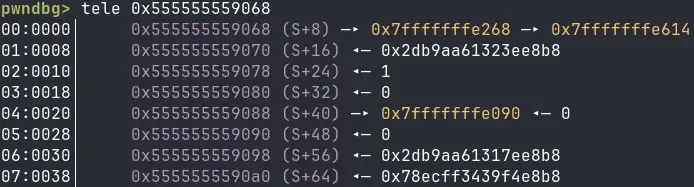
As you can notice, RBP, RSP, and RIP should all be addresses, but they got mangled in some way. This means that we cannot simply overwrite them with a new address to modify these registers.
breaking the mangling
By setting a breakpoint in the __longjmp function in GDB, it is possible to understand exactly how the function demangles the pointers.


It first executes a ror of 17 bits (0x11), and then it XORs the resulting value with a predetermined key taken from the Thread Control Block at offset 0x30 (fs:0x30).
This means that as long as we have a leak of the return address, it is possible, for example, to recover the key this way:
def recover_key(mangled_addr:int, real_addr:int): return ror(mangled_addr, 0x11, 64) ^ real_addrAfter that, we can mangle an arbitrary pointer by doing the reverse of the demangling operation:
def mangle_addr(real_addr:int, key:int): return rol(real_addr ^ key, 0x11, 64)CTF challenges
If you want to try this technique, I will add a list of challenges below:
- txvm (Teamitaly 2026 Quals): waiting for release